
Meet Phineas Gage: 25-year-old railroad foreman, hardworking, dependable… and soon to be the guy who accidentally spoiler-alerted the entire field of neuroscience.
The Day Cavendish Got Loud
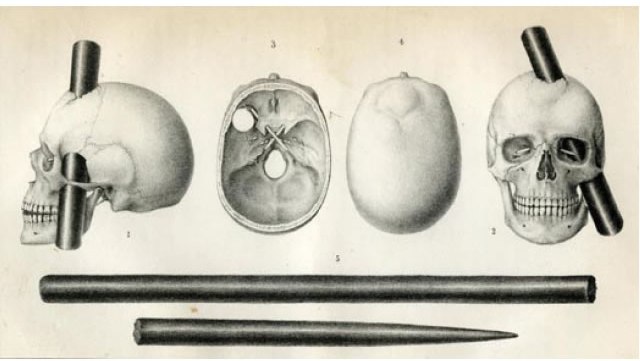
September 13, 1848. Cavendish, Vermont. Gage and his crew are blasting rock for the new railroad. Routine stuff. Drill, gunpowder, tamping rod. Except this time—spark. Boom. Suddenly the tamping iron launches itself straight through Gage’s cheek, out the top of his skull, and into medical history.
Any normal human? Dead. Phineas? He gets up, spits out some blood, travels back 1,2 km to his hotel in an ox cart and when Dr. Edward Williams shows up, he greets him with: “Doctor, here is business enough for you.” Imagine losing part of your brain and still delivering a mic-drop one-liner.
Dr. Harlow: The Man, the Myth, the Memo
Enter Dr. John Martyn Harlow. Local physician, part-time brain plumber, full-time note-taker, who takes on the patient. His first challenge? Stop the bleeding, remove bone fragments, and somehow deal with the fact that part of Phineas’s brain is now decorating the countryside. His second challenge? Infection – because antibiotics hadn’t been invented yet. He stops the bleeding, pulls out bone fragments, battles the infection with 19th-century “medicine” (spoiler: mercury chloride and rhubarb—basically poisoning your patient with vegetables), and somehow manages to save Gage’s life.
But Harlow’s real superpower wasn’t the medical care. It was the paperwork. He documented everything: the wound, the recovery, the fact that Phineas could walk, talk, and complain immediately after becoming a human unicorn. Without Harlow’s obsessive note-taking, Gage would’ve been a bar story. Instead, he became Exhibit A in neuroscience.
“No Longer Gage”
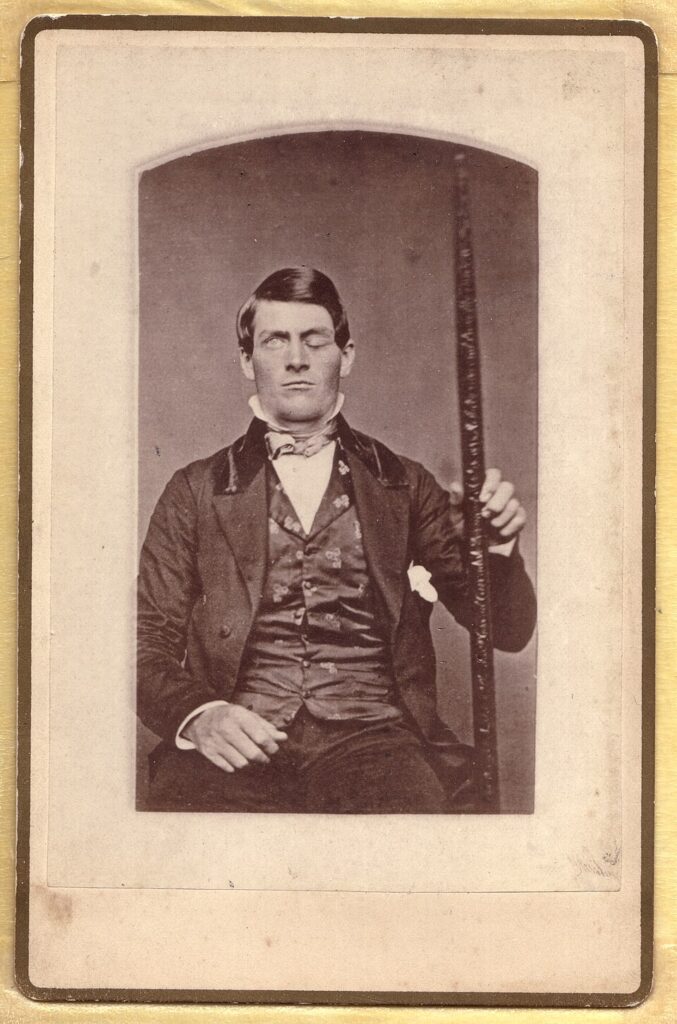
Then came the plot twist. Physically, Gage was fine-ish. Blind on the left eye, yes. Cognitively? Also fine. But personality-wise? Cue the horror soundtrack. The once responsible, mild-mannered foreman turned into a hot-tempered, foul-mouthed chaos agent. His friends said, “Gage is no longer Gage.”
Translation: when you lose your prefrontal cortex, you also lose the tiny inner voice that says, “Maybe don’t insult your boss in front of everyone.”
Bigelow, Ferrier, and the Case of the Missing Personality
Here’s where it gets messy. Harlow, in his first reports, didn’t mention the personality changes. Why? Maybe because Victorian society wasn’t ready to read, “My patient survived, but also turned into Deadpool without the sense of humor.” Or maybe he was just waiting for the right academic mic-drop.
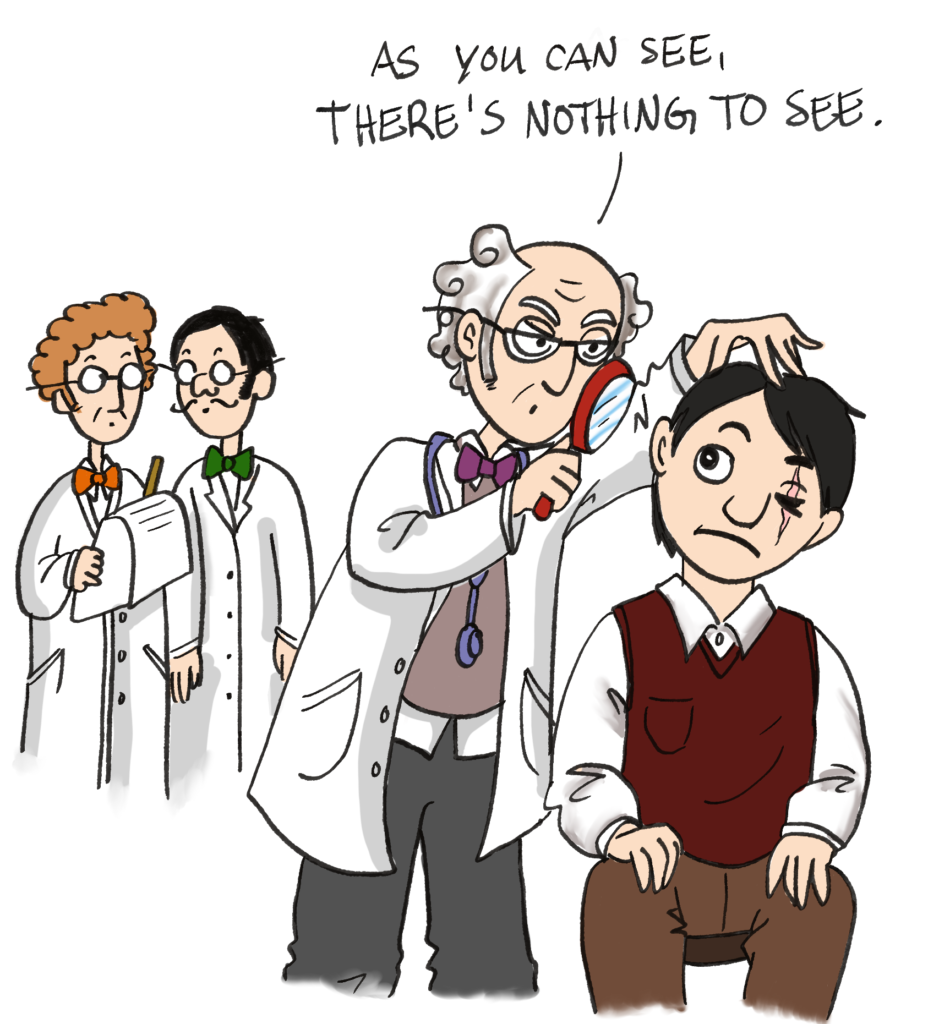
So, other doctors – like Harvard’s Henry Bigelow – stepped in. Bigelow examined Gage in 1850 and basically said: “Yeah, he’s missing a chunk of brain, but he’s fine. Totally fine. Nothing to see here.” That conclusion reinforced the idea that the frontal lobes were just empty attic space for your skull.
Enter David Ferrier, 1870s neurologist and big fan of monkey experiments. At first, Ferrier sided with Bigelow: Gage was living proof that frontal lobes were useless. But then he actually got hold of Harlow’s full 1868 report, the one where Gage’s personality changes are finally laid bare. Suddenly Ferrier has to walk it back: “Oh wait – frontal lobes aren’t useless. They’re where personality lives.” Cue dramatic academic backpedalling.
From Cavendish to the Birth of Psychosurgery
And here’s the kicker: this case didn’t just change theories – it planted the seeds for practice. Fast forward to 1890s Switzerland: surgeon Gottlieb Burckhardt thinks, “Hey, if messing up the frontal lobes changes personality, maybe I can intentionally mess with them to treat mental illness.”
Fast forward again to the 1930s: Egas Moniz takes that idea, turns it into the frontal lobotomy, and even wins a Nobel Prize for it. Yes, you read that right. Phineas Gage’s freak accident indirectly inspired decades of “treatments” that make modern medicine look back and say, “Wow, that escalated quickly.” Luckily, since then the “benefits” of lobotomies have been debunked and today the procedure is replaced by much saver medication.
And what happened to Gage in the end?
After the accident, Gage drifted through jobs, even driving stagecoaches in Chile (because who wouldn’t trust a guy with half a frontal lobe to manage six horses and passengers?). Eventually, seizures caught up with him, and he died in 1860.
Years later, Gage’s family decided to exhume his skull and hand it over to Harlow who preserved it, along with the infamous iron rod, which now live at Harvard’s Warren Anatomical Museum. Thanks to Harlow’s persistence, we don’t just know about Gage -we study him.
The Takeaway
So what did Phineas Gage teach us? Three things:
- The frontal lobe is basically your brain’s HR department. Lose it, and you lose your social filter.
- Good documentation matters. Without Dr. Harlow’s notes, Gage would’ve been a medical meme, not a case study.
- Science takes detours. From “frontal lobes don’t matter” → “they control personality” → “let’s cure mental illness by stabbing brains with ice picks,” all the way to modern neuropsychology.
Phineas didn’t ask to become the rock star of neuroscience. But thanks to one very determined doctor and a three-foot iron rod, he went from railroad foreman to the man who blew the lid off the mystery of the mind – literally.
References
Bigelow HJ. Dr. Harlow’s case of recovery from the passage of an iron bar through the head. Am J Med Sci. 20:13-22 (1850). https://collections.countway.harvard.edu/onview/files/original/fc61f61c95e9f2d82160a86b1f168664.pdf
Filho RVT. Phineas Gage’s great lecacy. Dement Neuropsychol 14(4) : 419-421 (2020). doi : 10.1590/1980-57642020dn14-040013
Garcìa-Molina A. Phineas Gage and the enigma of the prefrontal cortex. Neurologia 27(6): 370-375 (2012).
Haas LF. Phineas Gage and the science of brain localisation. Journal of Neurology, Neurosurgery, and Psychiatry 71(6):761 (2001). doi: 10.1136/jnnp.71.6.761
Harlow JM. Passage of an iron rod through the head. Boston Medical and Surgical Journal. 39:389-393 (1848). doi: 10.1056/NEJM184812130392001
Harlow JM. Recovery from the passage of an iron bar through the head. Publications of the Massachussets Medical Society. 2:327—47 (1868) http://resource.nlm.nih.gov/66210360R
Sevmez F, Adanir SS, Ince R. Legendary name of Neuroscience: Phineas Gage (1823-1860). Child’s Nervous System 38: 855-856 (2022). doi: 10.1007/s00381-020-04595-6