
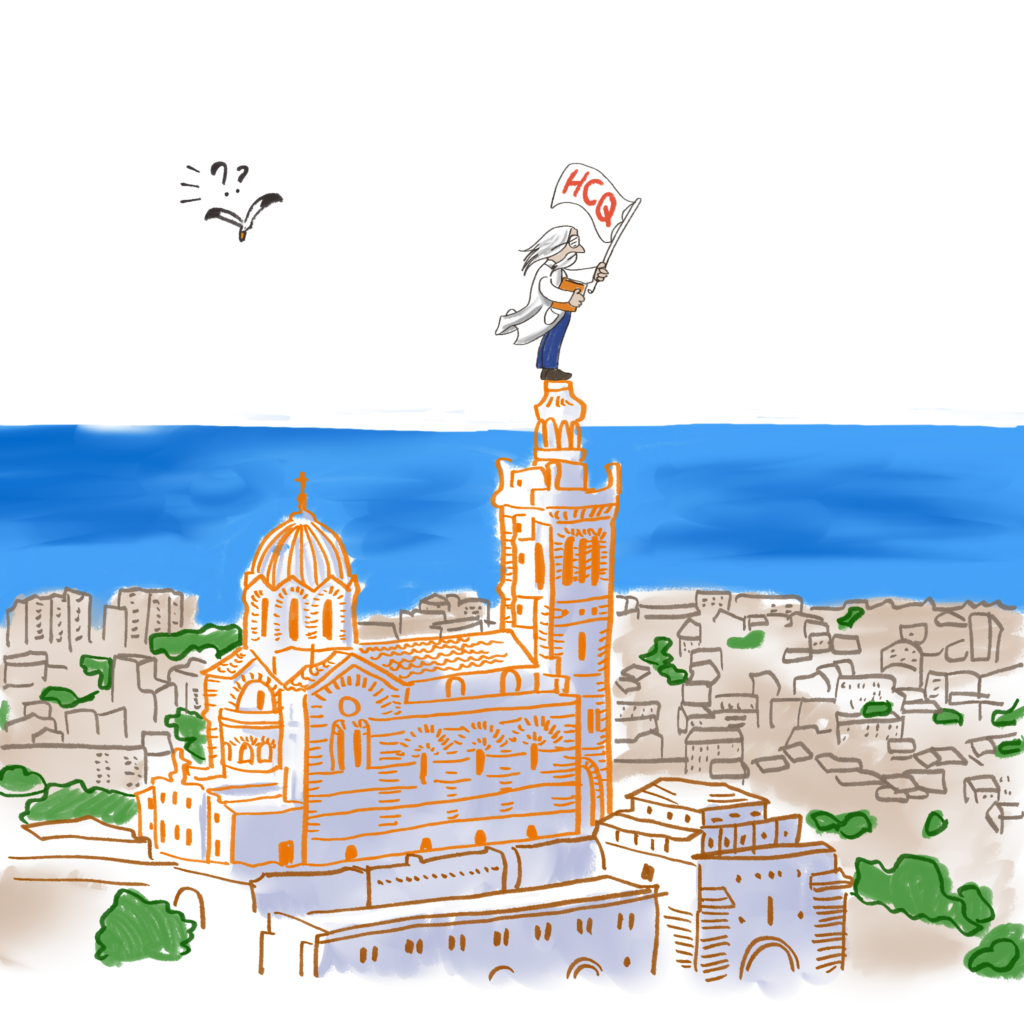
If you live in Marseille, you know the IHU building: shiny glass, palm trees, Mediterranean sun. Looks like a high-tech temple of science. But during the COVID pandemic, it became something else: ground zero for a global hype train, led by Professor Didier Raoult – microbiologist, YouTube star, and man with the most famous beard in French science.
The Paper That Launched a Thousand Headlines
You remember march 2020? Corona. Panic everywhere. No vaccines yet. Everyone’s desperate for a cure (while vigorously baking banana bread, obviously). But also, a big moment for many researchers that were pushed into spotlight, trying to explain and offer a scientifically founded solution for a never-before-seen crisis.
Enter Raoult’s team of the IHU with a paper in the International Journal of Antimicrobial Agents. Their claim? Hydroxychloroquine (HCQ) – a malaria drug – plus azithromycin (an antibiotic) wipes out COVID-19 in a matter of days. Voilà, pandemic solved.
The study had only 42 patients (already a red flag), but only 36 made it into the final results. Why? Because 6 were excluded: some got too sick, one died, another left the hospital. In other words: if you tank, you vanish from the dataset. Voilà, problem solved again.
Controls? Treated patients were at the IHU in Marseille. Controls were… in another hospital entirely. See the problem? Different place, different care, different everything. It was like comparing Paris Saint-Germain to your cousin’s five-a-side team and calling it “a fair trial.”
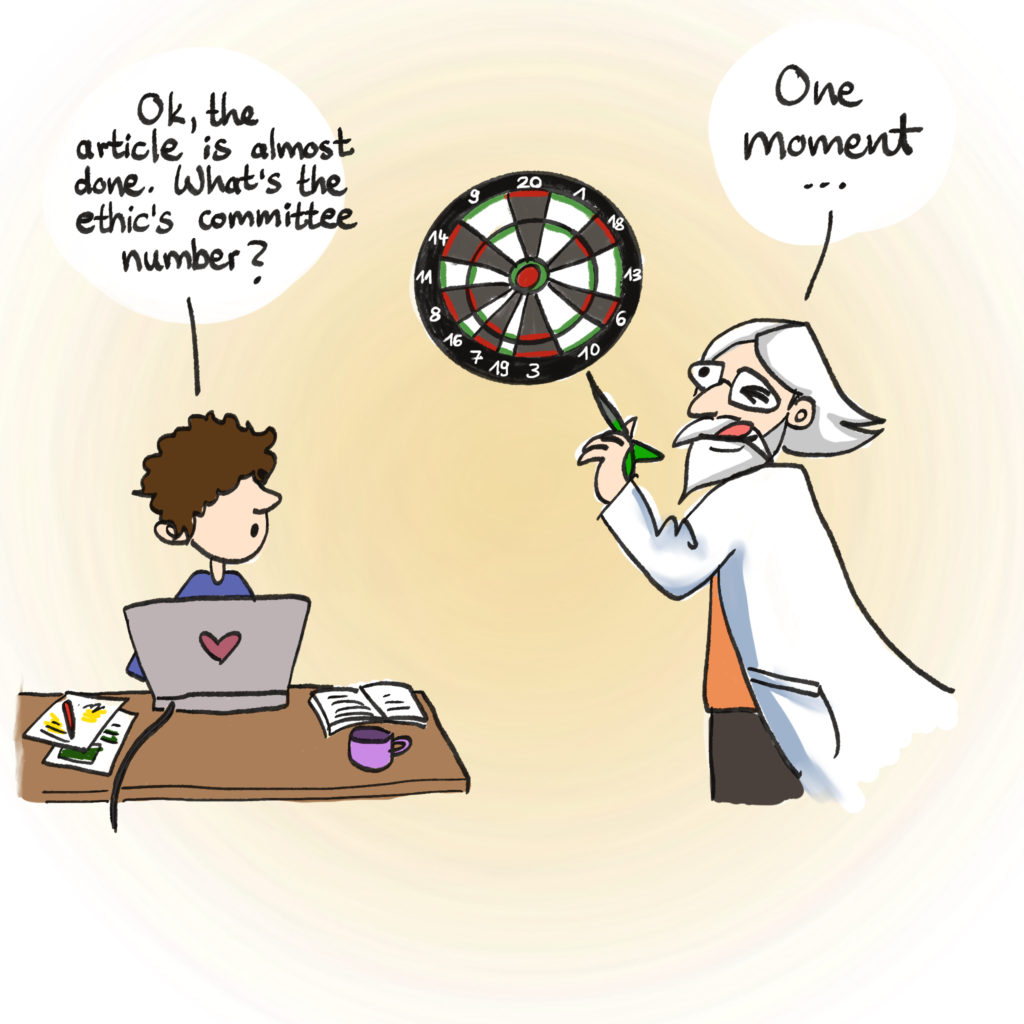
And the kicker: ethics approval for this study supposedly dated March 6 (Reminder: you are not allowed to do experimental research on human without ethic’s approval). But in this case the study looks like it started even before then. Unless Raoult invented time travel, or simply someone was a little too eager with the recruitment?
And the paper itself? Submitted on March 16, published only four days later on March 24 – that’s like going to the moon and back in 5 minutes instead of 6 days – a never-before-seen timeline.
The Rockstar Moment
Some researchers, for example microbiologist Elisabeth Bik, grew quickly suspicious of the paper but none the less the world went wild. Trump tweeted it. Fox News sang its praises. Brazilian politicians ordered HCQ like it was champagne. Sanofi increased its production by 50%.
For a brief, glorious moment, Marseille was the Mekka of medicine. People pilgrimaged to the IHU, waiting 5 hours to be able to enter. Pharmacies couldn’t keep chloroquine in stock. Patients begged doctors for prescriptions.
And Raoult? Having coffee with president Emmanuel Macron in Marseille, and getting a seat in the scientific council of the French government. Then his image started to crackle. He doubled down with his now-famous line: “I don’t believe in randomized clinical trials.” (Link Youtube) Rejecting basic scientific methodology is like a pilot saying, “I don’t believe in wings.” Cute philosophy, until the plane starts nosediving.
Ethics on Vacation
As more people poked around the IHU, the story got… messy. Not only for the infamous HCQ paper, but also past published papers and trials:
- Fast-tracked or missing ethics approvals: Several theses supervised at the IHU were defended with dubious or non-existent approval. ANSM (the French drug agency) later confirmed irregularities in multiple studies.
- Consent forms? Sometimes rushed, sometimes unclear, sometimes absent. Like downloading an app and finding out later you agreed to sell your kidneys.
- Retrospective studies dressed up as prospective: Raoult’s team sometimes collected data first, then went ethics-shopping after the fact. It’s like throwing a party, then asking the city for a noise permit when the police show up.
- Tuberculosis experiments: Reports revealed “wildcat” trials at the IHU on multi-resistant TB patients, using combinations of antibiotics outside normal protocols. Guess what, regulators were not amused.
- ANSM inspections: By 2021 and 2022, French authorities were formally investigating the IHU. Their reports spoke of “serious ethical breaches,” missing authorizations, and even risks to patient safety. When the official regulator uses phrases like “massive violations,” you know you’re not in the “oops, a typo” territory anymore.
In short: science was happening, but the rulebook was sitting somewhere on the beach at Plage de Prado, sipping pastis. C’est Marseille, bébé.
Despite the on-going criticism, Raoult held on to his theories and continued researching. Over-confidence? Ignorance? Thrill seeking? Who knows.
Criticism started to explode after the publication of a second study in 2021 that implicated … deep breath … 30.000 participants that were routinely treated with HCQ in Marseille! No official protocol, no ethics approval. This is considered the largest “wild” study to date. Regulatory authorities went bonkers.
The Retractions and the Reckoning
By 2021, the infamous HCQ paper was officially retracted after relentless criticism on PubPeer and watchdogs (thumbs up for Elisabeth Bik). Data inconsistencies, missing patients, magical recovery rates – pick your favourite problem.
Other Raoult-linked studies also fell under scrutiny. In total, more than a dozen publications have faced corrections, expressions of concern, or outright retractions.
Meanwhile, the French National Ethics Committee issued scathing opinions: the IHU’s work repeatedly failed to meet basic standards of patient protection. ANSM even filed complaints with the justice system. There goes the institute’s reputation down the toilet because of one media-hungry man.
The Aftermath
Did HCQ work? No. Multiple large randomized trials worldwide showed no clinical benefit. Stockpiles gathered dust. Patients who relied on it instead of proven treatments paid the price.
But the damage wasn’t just medical – it was cultural. Millions in and outside of France believed in a “miracle cure” because one charismatic professor said so. Politicians weaponized it. Conspiracies flourished.
And all this because a major research institute in Marseille decided that ethics and rigor were optional accessories.
And Didier Raoult today?
Well, after several investigations of the ANSM and Aix-Marseille University for scientific misconduct, he retired from his IHU director position in 2022. Yes, retired. Then, in 2024, l’Ordre des médecins (the guys that make sure that a doctor respects medical ethics) decided to retract his medical licence for two years. Better late, than never, I guess?
Today, Raoult is on the 12th position of the Reatraction Watch Leaderboard with more than 48 papers retracted to date (https://retractionwatch.com/the-retraction-watch-leaderboard/) (slow clap).
The Takeaway
- Ethics approvals aren’t paperwork; they’re the seatbelt of science. Skip them, and patients get hurt.
- Randomized trials are boring, but necessary. Otherwise, you’re just doing medical improv.
- Peer review isn’t supposed to be 24-hour drive-through. Fast food science gives you fast food results.
- And finally: if you pass by the IHU in Marseille, remember – it’s not just a building. It’s a cautionary tale of how charisma, shortcuts, and a catchy YouTube video can derail global science when we need it most.
References
Criticism on initial hydrochloroquine paper: https://pubpeer.com/publications/E09AC9D25125B0AB077971FBA6DD7B#21
“Didier Raoult doesn’t believe in randomized trials”: https://www.youtube.com/watch?v=7TI3Re57X2Y
https://www.afis.org/Didier-Raoult-contre-la-methode-scientifique#ref0
Wild trial on tuberculosis patients: https://www.mediapart.fr/journal/france/221021/ihu-de-marseille-les-ravages-d-une-experimentation-sauvage-contre-la-tuberculose
Thesis at IHU with doubtful ethics approval: https://www.lexpress.fr/sciences-sante/sciences/enquete-a-l-ihu-les-petits-arrangements-de-didier-raoult-avec-l-ethique-et-la-loi_2155083.html?cmp_redirect=true
Critics on study with 30.000: https://pubpeer.com/publications/458B11A77135BCB66656469E12F540
Criticism on preprint paper that includes 30.000 COVID-19 patients: https://pubpeer.com/publications/3543A87E349E2B7081592624198040
ANSM inspection report : https://ansm.sante.fr/actualites/inspection-a-lihu-mediterranee-infection-et-a-lap-hm-lansm-saisit-a-nouveau-la-justice-et-engage-des-poursuites-administratives